Perseids 2027: prediction of activity
to the list of predictions
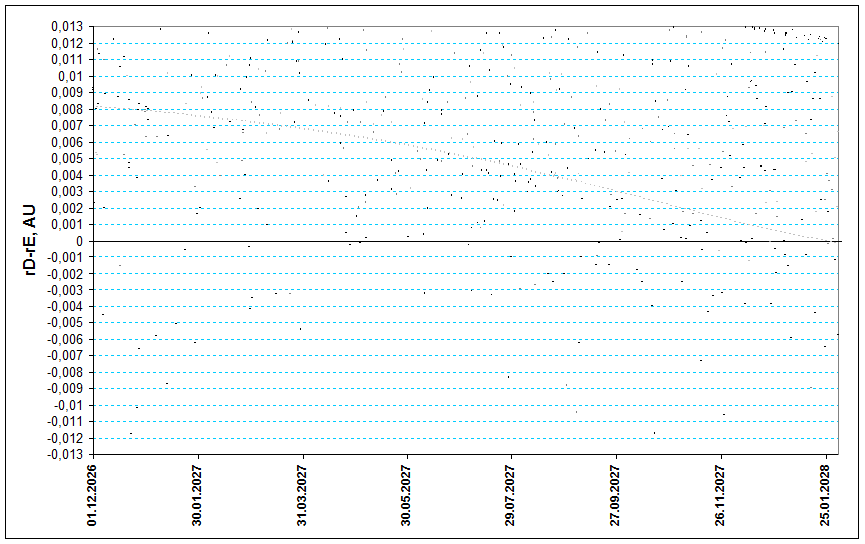
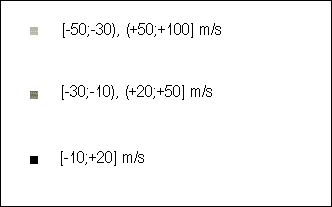
Fig. 1. Space-temporal projection of the Perseids trails parts onto their minimal distance passages in 2027 (correspondence between colours of the particles and their ejection velocities can be seen here).
In 2027 the Earth passes trough the part of the Perseids meteor stream that is subject to gravitational perturbation from Jupiter, which shifted it closer to the Earth orbit. Particles with maximum shift of ~0.01 AU will be met with Earth in 2028 when the Perseids are expected to be substantially more active than usual. In 2027 the shift will be not so large, ~0.006 AU. Nevertheless it could also cause some increase in Perseids maximum levels, appr. 10-20% higher, i.e. to 110-120 meteors per hour. Also at 2 UT on August 13 some rarified fragments of 1479 trail could also give some addition to background activity.
References
1. "Comet's dust 2.0" program by S. Shanov and S. Dubrovsky. [Used for orbital computations.]
2. E. Lyytinen, T. van Flandern "Predicting the strength of Leonid outbursts", 2000, Earth, Moon, and Planets, P. 149-166.
3. Jenniskens P. Meteor showers and their parent comets, 2006, 780 p. 4. Kasuo Kinoshita, http://jcometobs.web.fc2.com/ [Orbital elements of the comet P/2009 WX51 Catalina]
5. Hewgill G. Xearth 1.1.0 (Software program), 2003.