P/2009 WX51-ids: prediction of activity
to the list of predictions
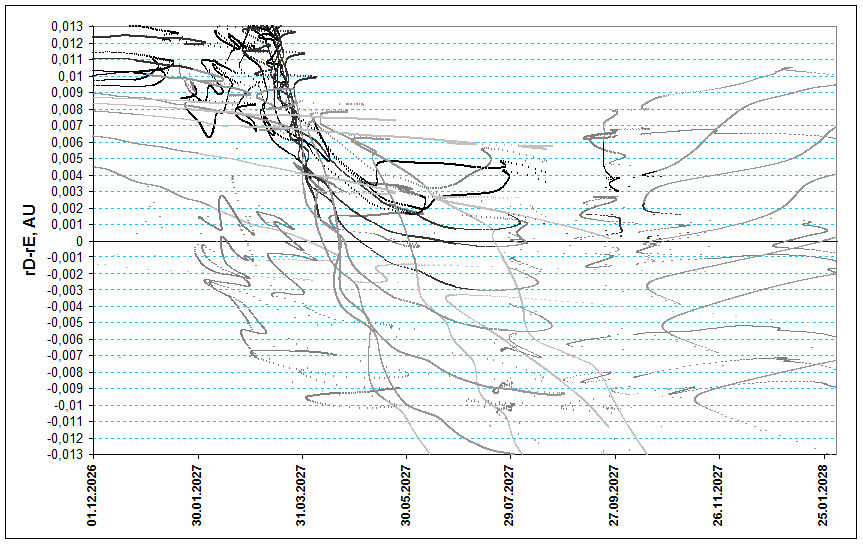
Fig. 1. Space-temporal projection of the P/2009 WX51-ids trails parts onto their minimal distance passages in 2027 (correspondence between colours of the particles and their ejection velocities can be seen here).
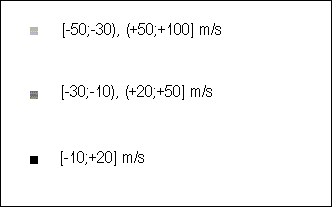
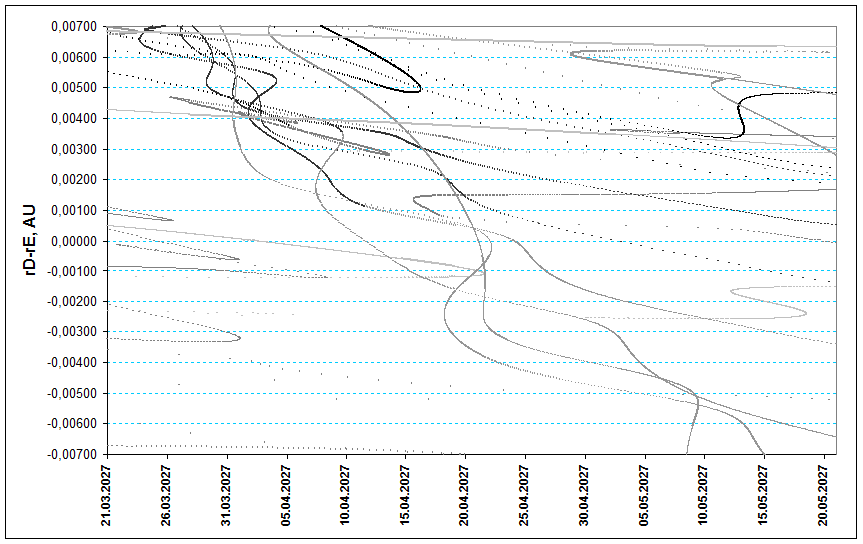
Fig. 2. Detailed space-temporal projection of the P/2009 WX51-ids trails parts onto their minimal distance passages in 2027 (correspondence between colours of the particles and their ejection velocities can be seen here).
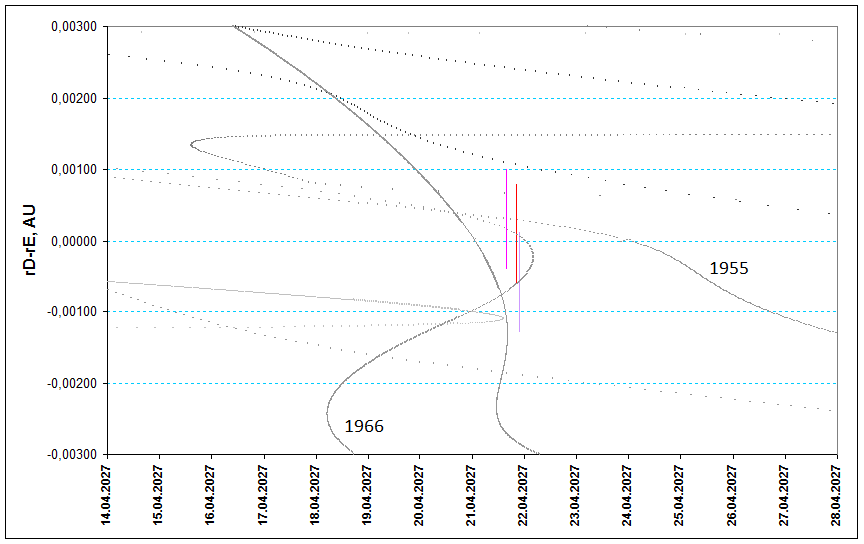
Fig. 3. Even more detailed space-temporal projection of the P/2009 WX51-ids trails parts onto their minimal distance passages in 2027 with marked moments of maxima from 1955 and 1966 trails (correspondence between colours of the particles and their ejection velocities can be seen here).
The comet P/2009 WX51 (Catalina) was discovered in 2009 as a very faint object having near-Earth orbit with the MOID of 0.0094 AU from the Earth's orbit in that year. Its cometary activity was very low, almost absent. In the subsequent perihelia of 2015 and 2020 the comet was not recovered while the perihelion of 2026 was still in the future at the time of this survey preparation.
This object despite its faintness deserves interest because of its quite sustainable near-Earth orbit with the MOID smaller than 0.02 AU from the perihelion of 1988 and finishing the future periheion of 2042. So far even in spite of current low level of cometary activity and therefore low amount of ejected meteor dust this comet could be more active it its past returns so its trails ejected in the middle of 20th century and before could be more rich with particles and therefore could produce notable activity outbursts in case the encounter to Earth.
We should note that current computations and their results are based on the single observed return of this comet in 2009, when it was observed only a few times, so they could be not very accurate and the orbit of the comet based on the single apparition is also perhaps defined not very accurately. More precise computations on this comet's meteor stream could be done if and when it is recovered with observations again, which should allow to obtain much more accurate elements of its orbit.
Anyway computations based on the current orbital elements of the comet P/2009 WX51 (Catalina) show that in 2027 on April 21 the Earth is expected to make three encounters with the trails of this comet ejected in 1955 and 1966. Parameters of encounters are given below:
21.04.2027 15:40 UT. Encounter with 1955 trail, расстояние до Земли - 0.00030 а.е., скорость выброса частиц 20.60 м/с, плотность шлейфа - 125% от плотности шлейфа Леонид 1 обращения. Теоретический радиант RA=38.1°, Dec=+34.8°.
21.04.2027 15:40 UT. Столкновение со шлейфом 1955 г., distance to the trails central axis - 0.00030 AU, particles ejection velocity is 20.60 m/s, trail density is 125% from that for a Leonids trail of 1 revolution. Theoretical radiant: RA=38.1°, Dec=+34.8°.
21.04.2027 20:29 UT. Столкновение со шлейфом 1966 г., distance to the trails central axis - 0.00009 AU, particles ejection velocity is 27.12 m/s, trail density is 325% from that for a Leonids trail of 1 revolution. Theoretical radiant: RA=38.0°, Dec=+34.5°.
21.04.2027 21:46 UT. Столкновение со шлейфом 1966 г., distance to the trails central axis - 0.00058 AU, particles ejection velocity is 27.49 m/s, trail density is 822% from that for a Leonids trail of 1 revolution. Theoretical radiant: RA=38.1°, Dec=+34.4°.
In case we had such parameters for some more intensive shower with larger parent object like, say, the comet 21P/Giacobini-Zinner, that such parameters would have meant high chances for a meteor storm, while in out case with the small and scarcely active comet P/2009 WX51 (Catalina) we could at best count on activity at the level of several dozens meteors per hour around the given moments of time.

Fig. 4. The Earth as seen from coming P/2009 WX51-ids meteors (RA=38.1°, Dec=+34.8°) during the expected maximum time of outburst from 1955 trail at 15:40 UT on 21 April.

Fig. 5. The Earth as seen from coming P/2009 WX51-ids meteors (RA=38.0°, Dec=+34.5°) during the expected maximum time of outburst from 1966 trail at 20:29 UT on 21 April.
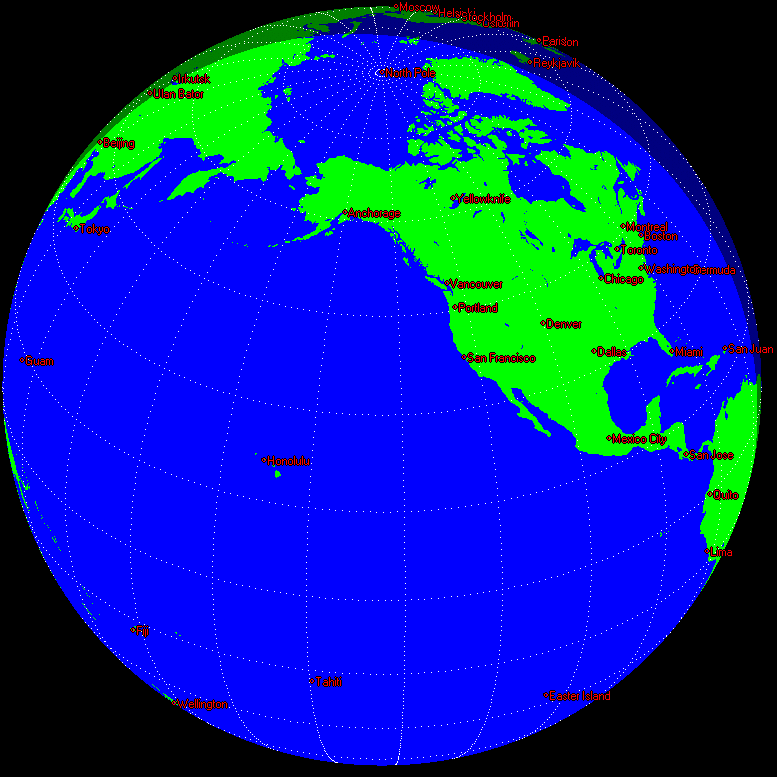
Fig. 6. The Earth as seen from coming P/2009 WX51-ids meteors (RA=38.1°, Dec=+34.4°) during the expected maximum time of outburst from 1966 trail at 21:46 UT on 21 April.
As could be noted on the Figures 4, 5 and 6, the observations of this showers are difficult because it is mainly a daylight shower, its radiant elongation from the Sun is only about 26 degrees. So far even in case of any activity occurs the observations under dark night sky are impossible for this shower. The only exclusion is some small narrow area of relative darkness with the Sun not deep under the horizon and low radiant altitude, which corresponds to the extreme upper part of visibility maps. Considering such restrictions for visual observations, more perspective for this shower should be radio and radar observations.
References
1. "Comet's dust 2.0" program by S. Shanov and S. Dubrovsky. [Used for orbital computations.]
2. E. Lyytinen, T. van Flandern "Predicting the strength of Leonid outbursts", 2000, Earth, Moon, and Planets, P. 149-166.
3. Jenniskens P. Meteor showers and their parent comets, 2006, 780 p. 4. Kasuo Kinoshita, http://jcometobs.web.fc2.com/ [Orbital elements of the comet P/2009 WX51 Catalina]
5. Hewgill G. Xearth 1.1.0 (Software program), 2003.
References
1. "Comet's dust 2.0" program by S. Shanov and S. Dubrovsky. [Used for orbital computations.]
2. E. Lyytinen, T. van Flandern "Predicting the strength of Leonid outbursts", 2000, Earth, Moon, and Planets, P. 149-166.
3. Jenniskens P. Meteor showers and their parent comets, 2006, 780 p. 4. Kasuo Kinoshita, http://jcometobs.web.fc2.com/ [Orbital elements of the comet P/2009 WX51 Catalina]
5. Hewgill G. Xearth 1.1.0 (Software program), 2003.